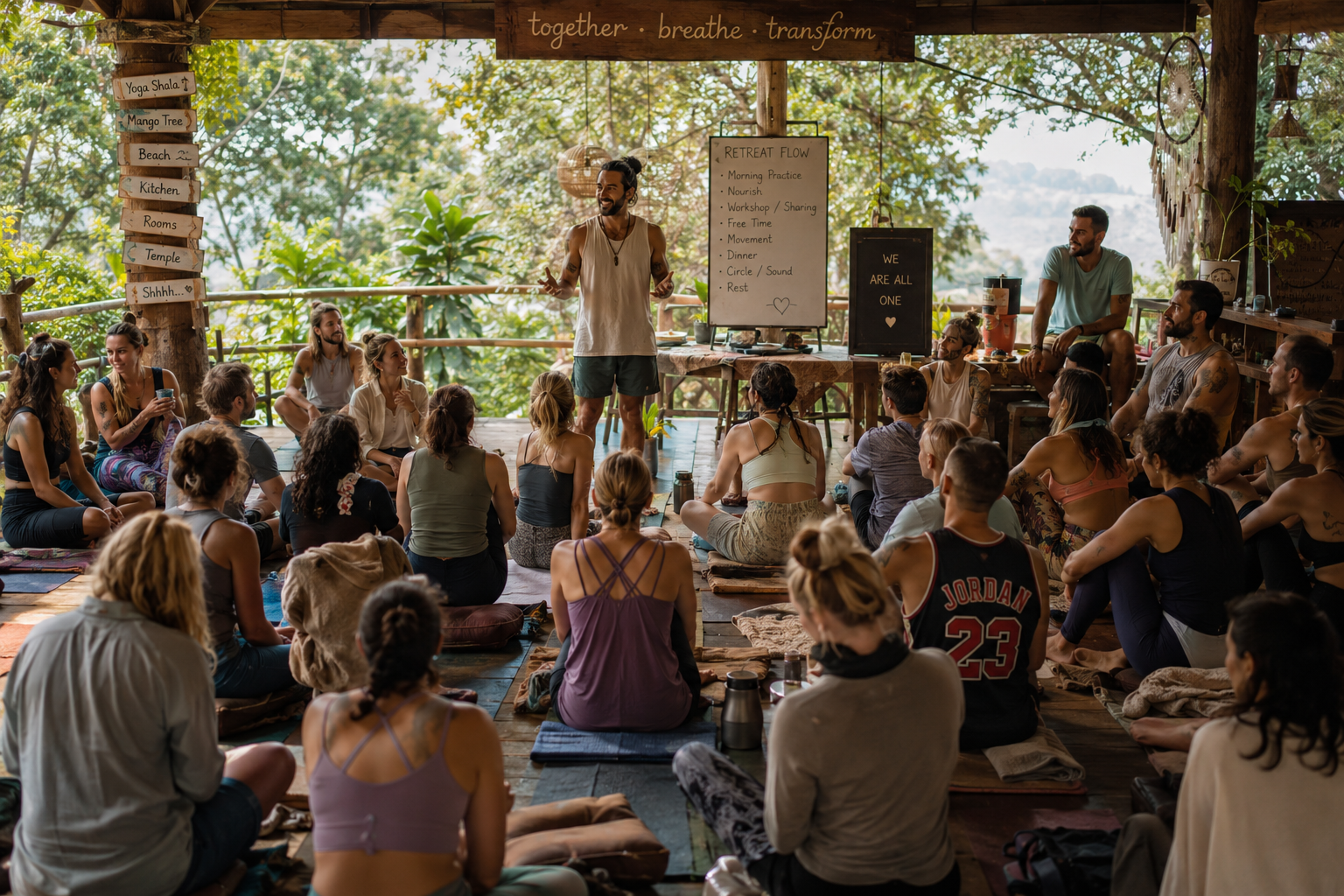
The most common assumption among teachers starting out with retreats is that the business is the retreat. You plan the retreat, you fill the retreat, you run the retreat, and that's the work. If the retreat is good and the marketing is good, the next one should be easier. Repeat.
The teachers who've been doing this for a decade tell a different story. They'll say, almost word for word: the retreat is the easy part.
Once you understand what they mean by that, the entire shape of a retreat business looks different.
The Hidden Engine
What they mean is this. By the time the retreat itself happens — the seven days in Tuscany or Bali or the Sierra Nevada — almost all of the real work has already been done. The participants are already in the van. The deposits have already been collected. The relationships were built months or years before any retreat was on the calendar.
The retreat is the visible part. It's what gets photographed and posted on Instagram. It's what students tell their friends about. But the business — the thing that produces a filled retreat year after year — is invisible. It runs in the background, between retreats, on what looks like ordinary teaching days.
That hidden engine is what actually pays. And it has four parts.
The Four Components
An ongoing audience. Not a follower count. Not a mailing list of cold leads. A real, identifiable group of people who know the teacher's name, have taken at least one class with them, and would recognize an announcement if they saw it. For most independent teachers, this audience is small — fifty to two hundred people. That's enough.
Recurring engagement. The audience isn't static. They show up to the weekly class. They read the occasional email. They reply to the Instagram story. They are in active contact with the teacher in some form, not constantly, but regularly enough that the teacher isn't a stranger to them. When the next retreat is announced, this audience doesn't need to be reminded who the teacher is.
Trust. This is the slow accumulation of small confirmations that the teacher is competent, honest, and worth committing to for several days in another country. Trust is built through consistency, not announcements. It's why a teacher who's been showing up to teach Wednesday-night class for four years can fill a retreat from a single email, while a teacher with ten times the social media following can't fill the same retreat with a paid ad campaign.
Warm community. Some of the audience knows each other. They've met at workshops, they've taken the same teacher training, they've ended up on the same WhatsApp group after a previous retreat. This is what makes retreats fill faster than the math should allow — past participants bring friends, and friends bring friends. The community does some of the marketing work invisibly, and the teacher rarely sees it happening.
None of these four is a retreat. All four are what make retreats possible.
The Flywheel
Here's the part most teachers eventually figure out, usually the hard way.
Daily classes feed retreats. Students who come to weekly class are the warm audience that a retreat gets announced to. A small percentage of them sign up. The retreat fills.
Retreats feed community. The eight people who spent a week together come home knowing each other. Some of them stay in touch. Some of them join future retreats together. The audience that was loosely connected through the teacher is now connected through each other, too.
Community feeds future retreats. The next time the teacher announces something, the audience isn't only the weekly-class regulars. It includes past retreat participants, their friends, and the slow word-of-mouth that comes out of a group of people who had a meaningful week together. The reach of an announcement compounds.
Future retreats fill faster, with higher trust, at higher prices, with less marketing effort. The teacher returns to weekly classes, the daily teaching continues, the audience grows. The flywheel turns again.
This is what a retreat business actually is. Not a series of retreats. A self-reinforcing system in which teaching, retreats, and community feed each other indefinitely.
What Goes Wrong When the Flywheel Isn't There
Most retreats that fail financially fail for a single reason: the teacher tried to run a retreat without the flywheel underneath it.
The classic version of this is the teacher who has just completed teacher training and decides their first move will be a retreat. There's no weekly class yet. There are no regular students. There's certainly no past-retreat community. The teacher launches a retreat, and discovers that filling eight seats from cold outreach is brutally hard and brutally expensive. Most of the runway gets spent on marketing that doesn't convert. The retreat either runs at a loss to honor the few who signed up, or gets quietly canceled.
The second version is the teacher who did have a weekly class, but treated it as a side activity while the "real" business — the retreats — was being built. The class shrinks from neglect. Regulars stop showing up. The teacher discovers that the retreat that filled easily two years ago now requires twice the marketing effort, because the audience that used to fill it has drifted away. The flywheel slowed down, and the teacher didn't notice until the next retreat tried to spin it.
The third version is the teacher who runs retreats but never builds the community side. Each retreat is a self-contained event. Participants go home and aren't connected to anything afterward. There's no shared WhatsApp group, no follow-up newsletter, no easy way for one retreat to introduce its participants to the next one. The flywheel never gets a chance to turn — each retreat starts from zero.
All three of these are versions of the same mistake: trying to extract retreats from a system that isn't producing them.
The Reframe
The teachers with sustainable retreat businesses don't think of themselves primarily as retreat leaders. They think of themselves as teachers who happen to run retreats. The distinction sounds semantic, but it isn't.
A retreat leader's job is to plan and execute retreats. The work is the retreats themselves.
A teacher's job is to show up to weekly classes, build relationships with regulars, send the occasional thoughtful email, stay in touch with past participants, foster connections between students, and — once or twice a year — channel all of that accumulated energy into a retreat. The retreats are the financial peaks (we've written separately about why retreats are the monetization peaks of a teaching business and about how classes and retreats feed each other), but the work — the actual sustained labor — is the teaching and the community-building that happens between them.
This is why ten-year retreat veterans give the advice they do. Build your weekly classes first. Stay in touch with past participants. Make sure people from previous retreats can find each other. Send the email even when there's no retreat to announce. None of this looks like "retreat business" work. All of it is what makes the retreat business possible.
What This Looks Like in Practice
Spending time on the flywheel rather than only on the next retreat tends to shift a few things.
The teacher protects their weekly class as the most important commitment in the calendar, not the least important. The Wednesday-night studio class is what produces the regulars that produce the retreat. Skipping it because you're "busy with retreat planning" is exactly backwards.
The teacher keeps a simple system for staying in touch with past retreat participants. Not a sophisticated CRM. A list of names, a regular check-in, a thoughtful email once a quarter. (We've written about why most retreat leaders are still running their businesses on Excel and WhatsApp, and what that costs them.)
The teacher creates small ways for the community to connect with itself. A WhatsApp group from the last retreat that doesn't get archived after the trip ends. An invitation to a free open class for past participants when they're in town. Whatever fits the teacher's style — but something.
The teacher announces retreats to the warm circle first, not to the wider internet. The first wave of signups comes from people who already know the teacher. The marketing budget can stay small because the audience is doing most of the work invisibly.
None of this is glamorous. None of it is what people picture when they imagine running a retreat business. All of it is what the teachers with sustainable retreat businesses actually do.
The Quiet Truth
If retreats are the visible peak of a teaching business, the flywheel is the invisible engine that produces those peaks. Most teachers who fail at retreats don't fail at retreats. They fail at the engine.
The retreat will only be as strong as the flywheel feeding it. And the flywheel — the audience, the engagement, the trust, the community — is built in slow, unglamorous, daily increments that have nothing to do with the next retreat on the calendar.
This is the work. Not the retreat. The retreat is just where the work pays.
If you're trying to think through what your flywheel actually looks like — what your warm audience is, who's in it, how to stay in touch with past participants between retreats — that's the work we love. Come tell us what you're building.
— Dana B. RetreatsOS
Further Reading
- Your Classes Pay the Rent. Your Retreats Build the Year. — the financial geometry of running a teaching business with both classes and retreats.
- Retreats Are the Monetization Peaks of a Teaching Business — why the peaks matter more than they look, and what they actually sell.
- How to Fill Your First Wellness Retreat Even With No Audience — what to do when the flywheel doesn't exist yet.
- Why Yoga Teachers and Retreat Leaders Are Still Running Their Businesses on Excel and WhatsApp — the operational gap that erodes the flywheel quietly over time.
RetreatsOS is the operational platform built specifically for independent retreat leaders. Public retreat pages, integrated registration, payment plans and deposit collection with automated reminders, a participant management dashboard, the Buddy Bot WhatsApp assistant, and the operational infrastructure that turns the administrative layer of running retreats into a solved problem. Learn more at retreatsos.com.