The Numbers Don't Lie (But They Do Sting)
What Facilitators Across Every Modality Are Actually Wrestling With This Summer
Every business has a leading indicator—a metric that reveals problems before they appear on the profit-and-loss statement. In the retreat industry, that indicator is fill rate.
This summer, one pattern is emerging with unusual consistency. Retreats are attracting interest. Inquiries are arriving. Registrations are coming in. Yet many facilitators are discovering that their events are settling into an uncomfortable middle ground: active enough to continue, but not full enough to become financially healthy.
That distinction is important. An empty retreat is easy to diagnose. A profitable retreat is easy to celebrate. The dangerous place lies between those two extremes, where an event appears successful on the surface but quietly underperforms financially. The venue is booked, suppliers are confirmed, marketing expenses have already been incurred and the calendar is committed, yet the final margin continues shrinking with every week that passes.
For many facilitators, this has become the defining business challenge of the season.
A more competitive market changes the economics
Consumer demand for transformational experiences has not disappeared. If anything, interest in wellness, mindfulness and personal development continues to grow globally. The challenge is that supply has grown even faster.
Over the last several years, thousands of new retreat leaders have entered the market. Yoga teachers now organize destination retreats. Coaches host immersive weekends. Breathwork practitioners, therapists, hiking guides and community builders all compete for the same discretionary spending.
Participants, meanwhile, have become more selective. A retreat is no longer evaluated only on its content or destination. Prospective guests compare accommodation quality, cancellation policies, payment flexibility, testimonials, photography, communication and booking experience before making a decision.
Retreat leaders are therefore operating in a market where expectations continue rising while competition becomes increasingly sophisticated.
The fill rate is rarely a marketing problem alone
When registrations slow, the instinctive response is often to increase marketing activity. More advertising. More social posts. More emails. More urgency.
Sometimes that works.
More often, however, weak fill rates are symptoms rather than causes.
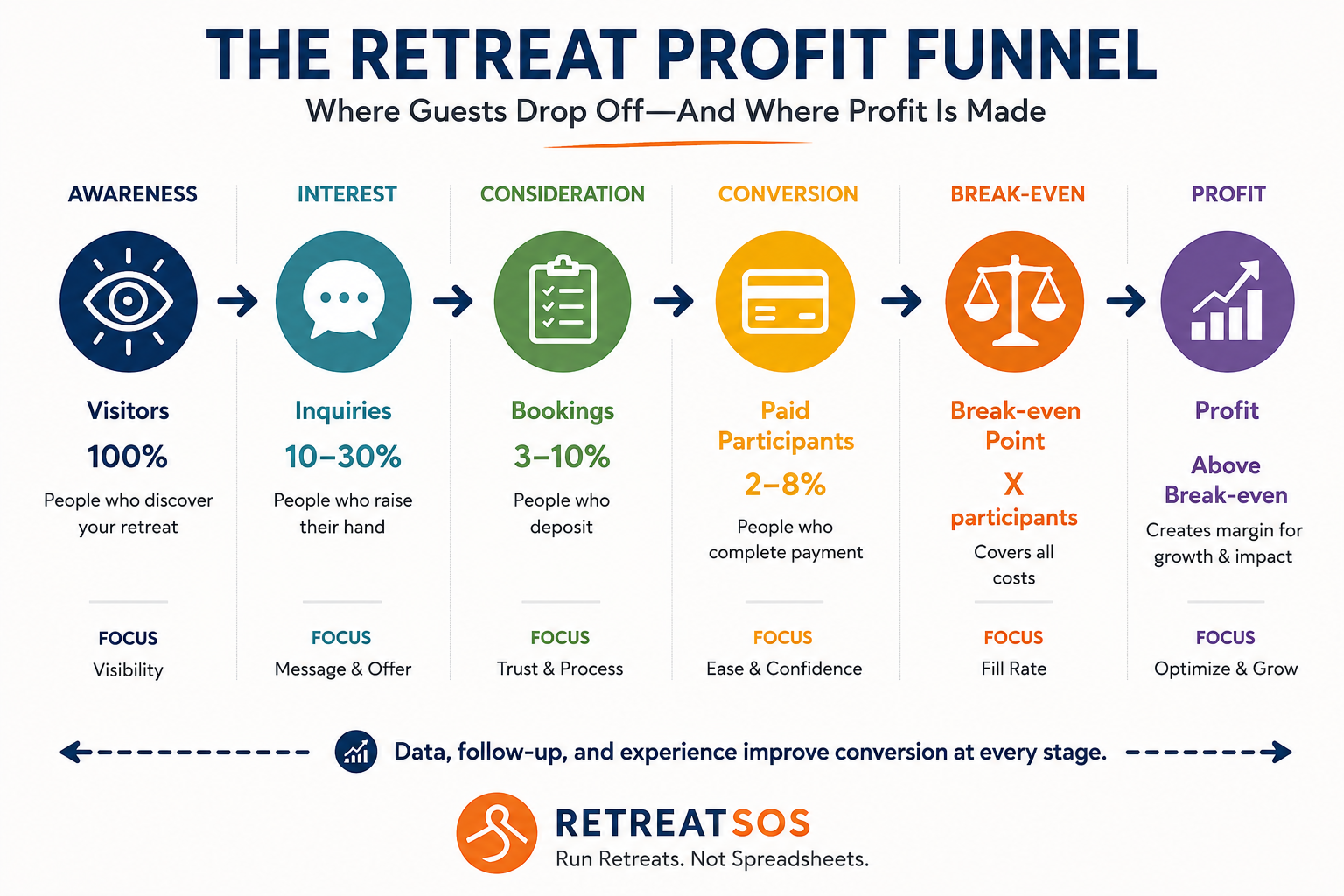
A retreat reaches profitability through the interaction of multiple business variables: pricing strategy, perceived value, audience targeting, launch timing, booking experience, trust signals, referral activity, payment options and follow-up discipline. Weakness in any one of these areas can reduce conversion. Several weak areas together can dramatically affect occupancy, even when awareness is high.
Businesses frequently assume they have a traffic problem when, in reality, they have a conversion problem.
Most facilitators operate with limited operational visibility
One observation appears repeatedly across small retreat businesses: leaders are forced to make strategic decisions without access to strategic information.
Questions such as Should I increase my advertising budget?, Is this retreat still recoverable?, Should I launch another event before this one fills? or Is discounting the right decision? often receive intuitive rather than analytical answers.
This creates unnecessary stress because uncertainty naturally encourages emotional decision-making.
In many cases, facilitators monitor social media engagement, email opens or booking notifications throughout the day, hoping to infer business health from fragmented signals. Yet none of these metrics independently explains whether the retreat is progressing toward profitability.
Businesses improve when leaders understand systems rather than isolated events.
The hidden cost of uncertainty
Financial pressure is only part of the problem.
The greater cost is cognitive.
Research across management disciplines consistently shows that uncertainty consumes attention. Decisions become slower, confidence declines and mental bandwidth is redirected away from strategic thinking toward constant monitoring.
For retreat leaders, this often manifests as checking registrations multiple times each day, rewriting marketing messages too frequently, questioning pricing decisions and feeling compelled to react immediately whenever bookings temporarily slow.
Ironically, these behaviours rarely improve outcomes. Instead, they increase fatigue while reducing consistency.
Operational clarity is not valuable simply because it improves reporting. It matters because it improves decision quality.
Teaching and administration are pulling in opposite directions
One of the most striking characteristics of the retreat industry is that commercial success often increases operational complexity faster than it increases personal satisfaction.
Every additional participant creates legitimate administrative work: confirmations, payments, room assignments, dietary requests, transport coordination, reminder emails, waivers, supplier communication and post-retreat follow-up.
Individually, each task appears manageable.
Collectively, they become a second profession.
This explains why many experienced facilitators describe themselves as spending progressively less time teaching and progressively more time managing logistics.
The irony is obvious. The very success they worked toward gradually distances them from the work that motivated them to begin.
What consistently successful retreat businesses do differently
While every retreat business is unique, successful operators tend to share several management habits.
They understand their break-even point precisely rather than approximately.
They monitor fill rate as a leading indicator rather than waiting for revenue reports after the event.
They review conversion throughout the booking journey, identifying where prospective participants disengage rather than assuming marketing alone is responsible.
They maintain regular communication with previous participants because repeat customers consistently represent one of the lowest-cost sources of future bookings.
Most importantly, they separate operational reviews from emotional reactions. Weekly business reviews replace daily anxiety.
None of these practices require a larger audience.
They require better management.
Five questions every facilitator should ask this week
Instead of asking, "Why isn't my retreat full?", consider asking:
-
Do I know my exact break-even occupancy?
-
Which stage of my booking journey loses the most people?
-
How many bookings came from returning participants versus new marketing?
-
What metric tells me whether my business is becoming healthier each week?
-
If someone else were managing this retreat, what decision would they make based purely on the numbers?
These questions shift attention from symptoms toward causes.
That is where meaningful improvements usually begin.
The numbers are not the enemy
Many facilitators understandably feel uncomfortable discussing metrics. Their work is deeply human. It centres on transformation, connection and wellbeing.
Yet numbers are not opposed to purpose.
They are evidence that purpose can continue.
Profit funds future retreats.
Healthy occupancy creates stability.
Reliable cash flow reduces burnout.
Operational visibility protects creativity because it removes unnecessary uncertainty.
Perhaps the strongest lesson emerging this summer is that sustainable retreat businesses are no longer built solely through exceptional teaching. They are built through exceptional teaching supported by disciplined business management.
The facilitators most likely to thrive over the coming years will not necessarily have the largest audiences or the most polished social media presence. They will be the ones who understand the numbers behind their work, recognise what those numbers are telling them and respond early rather than emotionally.
The numbers may sting.
But they are also the clearest conversation your business is trying to have with you