The Day I Stopped Being My Own Customer Service Department:
I want to tell you about a Tuesday in February.
It was 11:47 PM. I had just finished answering the same question — "what time is the airport pickup on Saturday?" — for the seventh time that day. The seventh. Same retreat. Same airport. Same time. Seven different participants. Seven nearly identical messages I'd typed out, each one with a slightly different friendly opener so it wouldn't feel like a copy-paste, even though it was definitely a copy-paste.
I closed WhatsApp. I opened it again. There was a new message. "Hi! Quick question about the Saturday pickup..."
That was the night I knew something had to change.
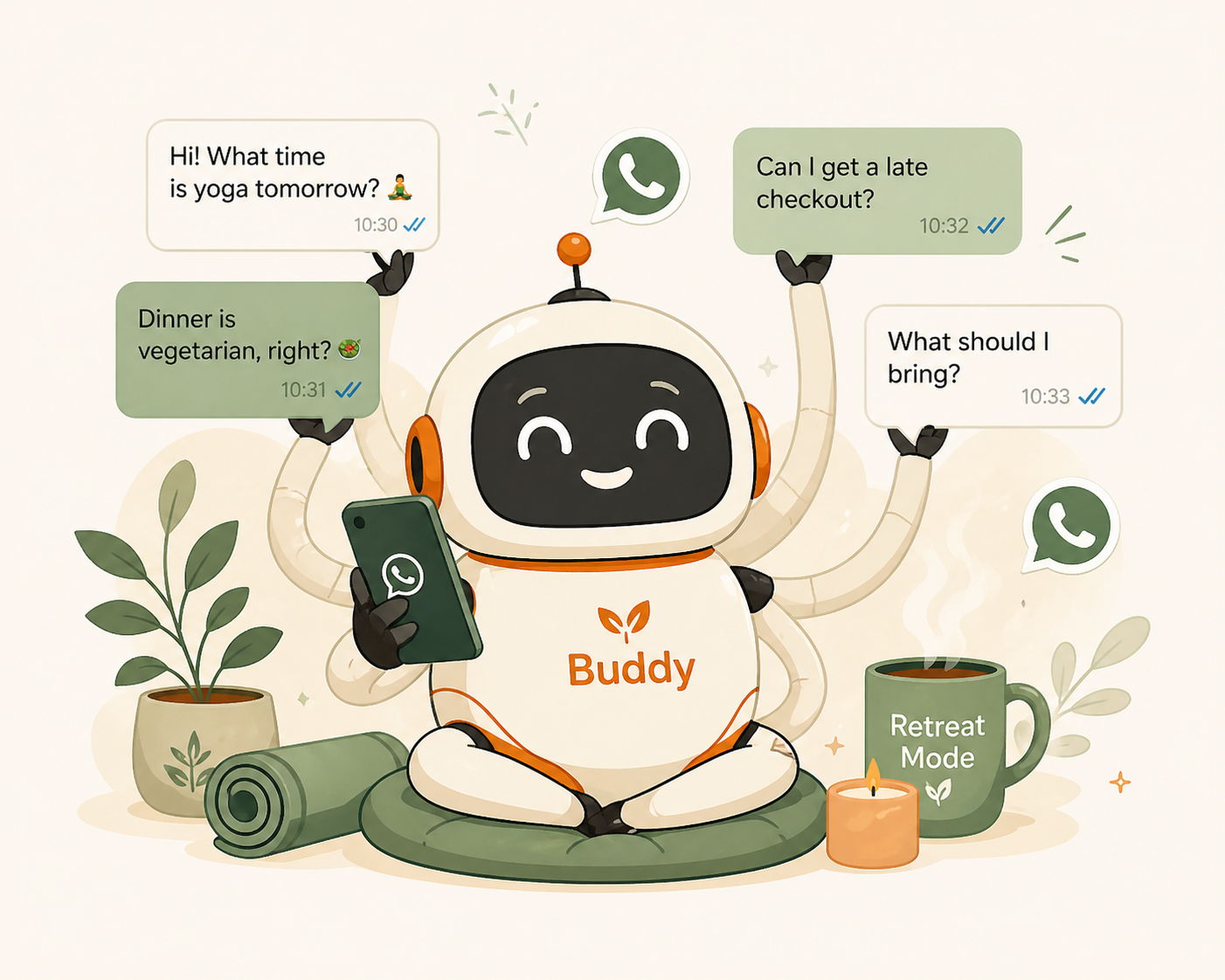
This article is for every retreat leader, yoga teacher, and small business owner who has ever sat on the bathroom floor at 11 PM, phone in hand, answering the same question for the eighth time that day, wondering whether this was actually the life they signed up for. It's the story of when I introduced Buddy Bot — the participant-facing chatbot we built into RetreatsOS — into my own daily workflow, what changed, and why I now genuinely don't understand how I lived without it.
Fair warning: parts of this will sound like an advertisement. They're not, technically — I built the thing, so I'm biased, but I'm not going to pretend the experience of using it was anything other than what it was. It was a small revolution in my life. I'm telling you about it because if you're in the same boat I was in, you deserve to know that the boat is escapable.
The Old Days: A Brief, Painful Survey
Before Buddy, my participant communication looked roughly like this:
6:43 AM. First message of the day. "Hi! Sorry to bother you so early — does the retreat have vegetarian options?" My website, the registration page, the welcome email, and the FAQ all say the retreat has vegetarian options. The participant has signed off on the form confirming her dietary preferences. The information exists in fourteen places. She is asking me anyway.
8:12 AM. "What's the WiFi password at the venue?" The retreat starts in three weeks. We are not at the venue. There is no WiFi password yet. I explain this. Politely.
10:30 AM. "What should I pack?" There is a packing list. It was sent in the welcome packet. It is also pinned in the WhatsApp group. It is also linked on the website. Three locations. I send it again.
12:45 PM. "Do you accept dogs?" We do not. We have never accepted dogs. The website is clear on this. The registration form has a question that says "do you have any pets you plan to bring." She did not select yes. She is now mentioning the dog.
3:20 PM. "What time does the retreat start on Friday?" The schedule has been sent. Twice. It is also on the website.
5:55 PM. "Are you the same person who teaches the Tuesday class?" I am.
7:30 PM. "Can you remind me what I paid as a deposit?" She has a receipt. Multiple receipts. I check our records. I tell her. She thanks me. She apologizes for asking. She apologizes again. I tell her not to apologize. We exchange seven more messages, each apologizing more profusely than the last.
11:47 PM. Someone asks about the Saturday airport pickup. Again.
This was not an unusual day. This was a normal Tuesday. And every retreat leader reading this is nodding right now, possibly with the painful recognition of someone who has lived through identical Tuesdays.
The Reality Nobody Wants to Admit
Here's what I came to understand during my third year of running retreats: the actual job of a retreat leader is mostly answering the same questions over and over again, with the occasional brief interruption to teach yoga.
I'm exaggerating. But not by much.
When I started running retreats, I imagined the role would be roughly: 70% leading practice, 20% designing programs and choosing venues, 10% logistics. Living the dream. Communing with the universe. Dispensing wisdom in mountain settings.
The actual breakdown was approximately: 5% leading practice, 5% designing programs, 5% communing with the universe, and 85% answering some variant of "what time does it start" via WhatsApp from people who already had the answer.
This is not the participants' fault. People who are about to drop $3,000 on a week-long experience are nervous. They want reassurance. They want a human to confirm what they've already read three times. They want to know that someone is taking this seriously and will pick up the phone if anything goes wrong. Their anxiety produces messages, and their messages produce my reply, and my reply produces relief, and relief produces the next message.
This is also not specifically a yoga thing. I've talked to climbing guides who deal with the exact same pattern, surf school operators who have given up trying to do anything else, retreat leaders across every vertical who privately admit that their job is mostly customer service with some occasional teaching mixed in.
But here's the part that started to bother me: none of these messages required me, specifically. The participant didn't need me to tell her about the airport pickup. She just needed someone — anyone — to confirm what was already documented. The same five answers, in slightly different wording, would have served 80% of the questions I was getting.
Which is exactly the moment Buddy Bot stopped being a vague idea on a roadmap and became a thing I needed to ship before I lost my mind.
Enter Buddy: The First Two Weeks
I'm going to skip the technical part of how Buddy was built. (If you want to nerd out about WhatsApp Cloud API integration, it's covered in our broader piece on retreat operations, and it's frankly less interesting than what happened once it was running.)
What matters is what happened in week one.
The first morning Buddy was live, I woke up to nine messages in WhatsApp — and seven of them already had answers. Buddy had handled the first wave of "what time does it start" and "what's the dietary policy" and "do you have shampoo at the venue" before I'd even reached for my coffee.
I sat in bed for a full minute, holding my phone, feeling something unfamiliar. It took me a while to identify it.
It was relief. Just normal, low-grade, human relief. The relief of not having seven small fires already burning in my morning before I'd had a chance to be a person.
By day three, I had stopped checking my phone the moment I woke up. By day five, I had genuinely forgotten about a participant question for the first time in three years — not because I was being negligent, but because Buddy had answered it at 2 AM and the participant was already settled, no follow-up needed from me. By the end of week one, I was answering maybe a third of the messages I'd previously been answering, and the ones reaching me were actual interesting questions that needed me — questions about the practice, questions about whether the retreat was right for them, conversations that were meaningful.
The relief didn't feel dramatic. It felt structural. Like something that had been pressing on me for years had quietly stepped off.
What Buddy Actually Does (Without Making It Sound Like a Brochure)
The simplest description: Buddy is a participant-facing chatbot that lives on WhatsApp and handles the routine questions that 80% of retreat participants ask. It knows the schedule. It knows the dietary policies. It knows the packing list, the venue location, the airport details, the cancellation policy, the dress code, the pricing, the deposit status of each participant, and the time zone the retreat runs in.
When a participant messages with a question Buddy can handle — which is most of them — it answers immediately, in friendly natural language, with the right information. When a participant asks something Buddy can't or shouldn't handle — a real concern, an emotional message, a question about the practice itself — it hands the conversation to me, with context, so I can respond properly.
The result is that the routine questions get answered instantly, twenty-four hours a day, in any language the participant speaks, without me being involved. The questions that need me get filtered to me, in priority order, with no noise around them.
It is a remarkably stupid-sounding intervention. It is also the single most impactful operational change I've made in five years of running this business.
The Specific Things That Changed
Here are the changes, in roughly the order I noticed them.
The morning was mine again. Mornings used to be a frantic catch-up on overnight messages from participants in different time zones. Now, mornings are mornings. I have coffee. I do my own practice. I read something. By the time I open my phone, Buddy has already handled most of what came in, and what's left is a small, manageable list of actual conversations that deserve attention.
Sleep returned. I used to wake up at 2 AM and check my phone, "just to make sure nothing urgent had come in." (Spoiler: nothing urgent ever came in. Participants asking about packing lists at midnight are not, despite their tone, having an emergency.) After Buddy, the urge to check my phone at night faded within a week. I sleep through the night now. This sounds small. It isn't.
Participants got better service, not worse. This was the part I genuinely didn't expect. I had assumed that introducing a bot would feel impersonal to participants — that they'd notice they were talking to a robot, feel slighted, and like the experience less. The opposite happened. Participants got their questions answered in thirty seconds at any hour of any day, in their own language, accurately. My average response time went from "between four and twelve hours" to "instant." Participant satisfaction went up sharply, even though I was personally involved in fewer conversations. Several participants told me, unprompted, that the communication during the retreat preparation was "the smoothest they'd ever experienced." I'd done less work and produced a better experience.
Income went up. This was unexpected. I'd installed Buddy thinking about saving time, not making money. But two things happened. First, my retention improved — participants who'd had a smooth pre-retreat experience were more likely to book the next one. Second, I started running an extra retreat per year, because I had the operational capacity I hadn't had before. The combination meant my annual revenue rose by something close to 35% in the year after I deployed Buddy. None of that was from working harder. All of it was from the time and energy that had previously been absorbed by repetitive messaging now being available for actual business growth.
The stress baseline dropped. I didn't fully appreciate how much background stress I'd been carrying around participant communication until it stopped. I'd been in a low-grade state of "someone might be messaging me right now" for three years straight. After Buddy, that state went away. I could put my phone down for an afternoon without anxiety. I could go to dinner with friends and not check WhatsApp every fifteen minutes. I could exist as a person who occasionally also runs retreats, instead of a customer service worker who occasionally has a personal life.
My own practice came back. I'm a yoga teacher. I'm supposed to have a practice. For three years, my practice had eroded because every time I sat down on the mat, I felt the pull to "just check my phone first." After Buddy, that pull faded. I'm now back to a daily practice for the first time since I started running retreats. Which is, you know, kind of important to my actual job.
The Stories I Hear From Other Operators
Once Buddy was live in my own business, I started installing it for other retreat operators we work with. The stories that come back are remarkably consistent.
A friend who runs surf retreats in Portugal told me that for the first time in her ten-year career, she'd spent a full retreat day actually surfing, instead of being on her phone managing logistics. "I forgot I was good at this," she said. She'd genuinely forgotten that surfing — the thing her business is built around — was something she enjoyed.
A climbing guide in Spain told me that the most surprising thing about Buddy was that his wife stopped being annoyed at him during retreats. "She used to call them my 'phone weeks' — I was at home but I wasn't really there. I'm there now."
A yoga teacher in Bali told me that she cried the first time Buddy handled a 3 AM message from a participant in a panic about her flight, calmly walked her through the rebooking instructions, and left a note for the teacher to follow up in the morning. "I've never been able to be that helpful at 3 AM," she said. "I was always asleep, or pretending to be asleep, or actually answering and then resentful all the next day. Buddy was just...helpful. With nothing on the other end of it."
These are not life-changing stories. They're small. But the smallness is the point. The accumulation of small relief over months adds up to a different kind of life.
What Buddy Doesn't Do
In the interest of honesty, here's what Buddy isn't:
It isn't a replacement for the teacher. It doesn't lead practice. It doesn't make program decisions. It doesn't have the wisdom or judgment to handle a participant in crisis. It doesn't replace the genuine relationships that retreat work depends on.
It isn't perfect. It occasionally misunderstands a question and gives an answer that's slightly off-target, at which point a participant says something like "I don't think you understood my question" and the conversation gets handed to me. This happens maybe once or twice per retreat. It's fine.
It isn't invisible. Some participants notice, very early in the conversation, that they're talking to a bot. (Buddy doesn't pretend to be human — it's transparent that it's an assistant, and it has its own personality.) Most participants don't seem to mind, and several have told me they actively prefer it because the bot is "less judgmental than a person" when they're asking a question they think might be silly.
It isn't optional once you've used it. This is the part that surprised me most. After two months of running with Buddy, the idea of going back to handling all participant communication myself feels approximately as appealing as the idea of going back to using a flip phone. The relief is the kind you don't appreciate until you have it, but once you have it, you can't imagine doing without it.
The Recommendation, Without the Hard Sell
If you're a retreat leader still handling all your participant communication personally — through WhatsApp, email, text, or a chaotic combination of all three — I want to say something direct: you do not need to keep doing this.
The technology to handle 80% of your participant communication automatically, accurately, and in a way participants actually prefer, exists. We've built it into RetreatsOS specifically because we saw how much it changed our own life and the lives of the operators we work with. Buddy is part of the platform, not a separate product, and it's designed to integrate cleanly with everything else — payments, participant management, scheduling, the works. Our broader piece on what makes a retreat operation actually professional covers the full operational picture this fits into; this article is about the specific piece that, in my experience, changes daily life the most.
I'm not going to tell you that adopting Buddy will transform your business. (It probably will, but you should hear that from someone less biased.) I'll tell you what it actually did for me: it gave me back my mornings, my evenings, my sleep, my own practice, and somewhere around 35% more annual income, in exchange for installing a piece of software that took less than an hour to set up.
If that exchange sounds interesting, come take a look. If it doesn't, that's fine too — but at least know that the choice is available. Most retreat leaders don't realize it is.
The Tuesday-night-on-the-bathroom-floor pattern doesn't have to be the rest of your career. It really, genuinely doesn't.
Further Reading
If this article resonated, we've written more about the operational and business realities of running retreats:
- What Makes a Yoga Retreat Genuinely Successful — for the Teacher and for the Participants — the full operational picture across all three phases of a retreat
- Breaking Even Is Not a Business Plan — the financial reality of independent retreat operators and what changes break-even into profitability
- Why Yoga Teachers and Retreat Leaders Are Still Running Their Businesses on Excel and WhatsApp — the broader operational gap that this article addresses one specific piece of
- The Silent Facebook Groups: Why Retreat Communities With 200,000 Members Have Zero Engagement — why conventional marketing channels fail for retreat operators
- What Is a Retreat, Really? — the foundational definition of the work
Follow our Facebook page for new articles as they're published.
RetreatsOS is the operational platform built for independent retreat leaders. Buddy Bot is included as part of the platform, alongside integrated payments and deposit collection, payment plans with automated reminders, a participant management dashboard, full lifecycle communication, and the operational infrastructure that lets retreat leaders focus on teaching rather than firefighting. If the Tuesday I described in this article sounded familiar, we're probably building for you. Learn more at retreatsos.com.