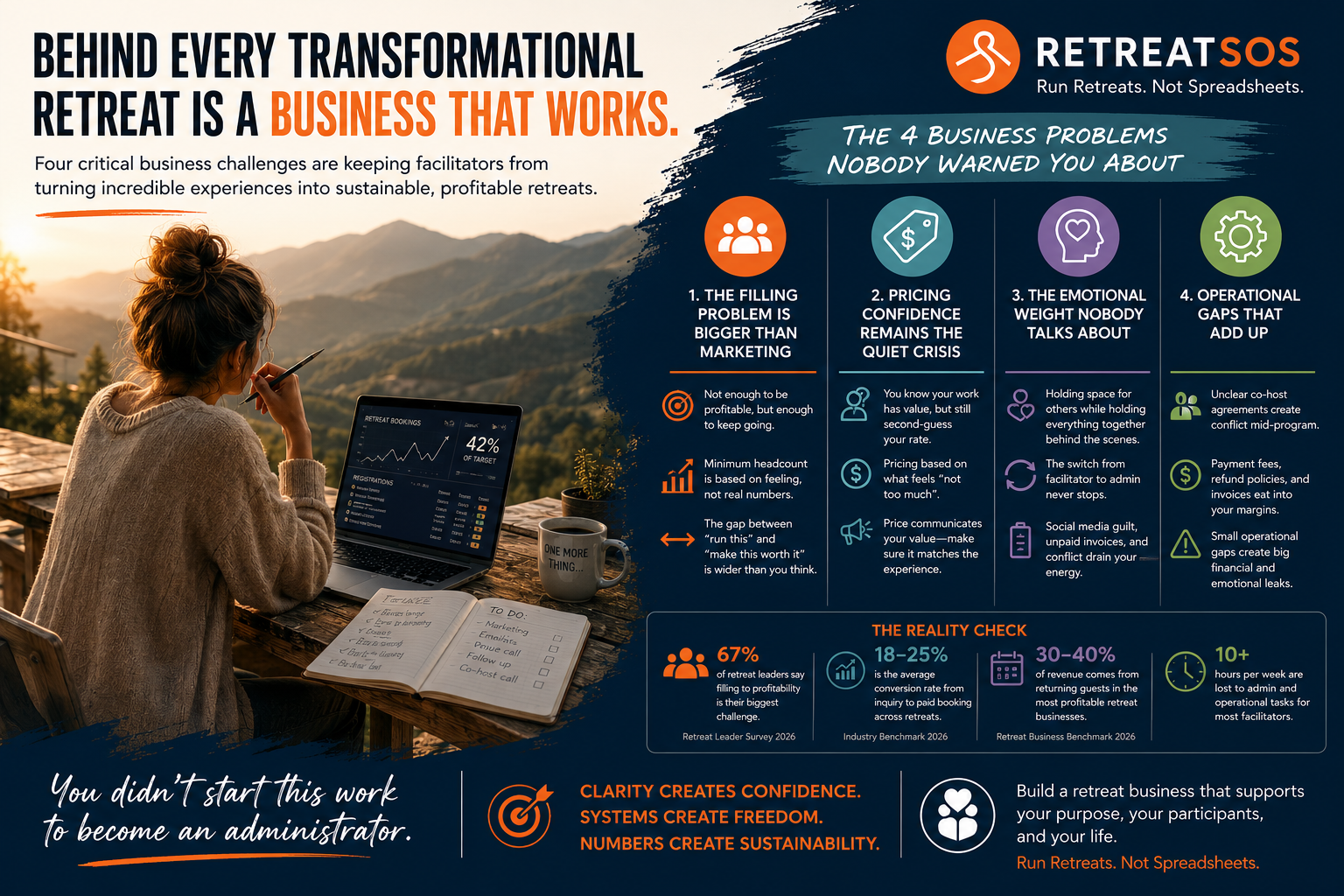
The Business Behind the Practice Is Exhausting Everyone
What facilitators are actually saying this summer — and what it points to.
For many retreat leaders, this wasn't supposed to be the hard part.
Holding space.
Teaching.
Guiding people through transformation.
Creating meaningful experiences.
That's why they started.
But somewhere along the way, another full-time job quietly appeared.
And this summer, it's becoming impossible to ignore.
"The retreat is happening... but I don't know if it's worth running anymore."
Over the past week alone, one theme surfaced again and again.
Not from one type of facilitator.
Not from one country.
Not from one teaching style.
Yoga teachers.
Breathwork facilitators.
Meditation guides.
Women's retreat hosts.
Surf retreat organizers.
Different people.
Exactly the same conversation.
The retreat isn't empty.
But it isn't full enough.
Which creates the worst possible situation.
The venue still needs paying.
Food still costs the same.
Flights are booked.
Suppliers expect deposits.
Marketing keeps consuming money.
The event goes ahead...
...but the profit quietly disappears.
Nobody teaches you this part
Teacher trainings spend hundreds of hours on philosophy.
On anatomy.
On sequencing.
On holding emotional space.
Very few spend even a single afternoon explaining questions like:
-
How many people do I actually need before I break even?
-
When should I increase my marketing budget?
-
When should I cancel?
-
Which retreat deserves my attention today?
-
Why did registrations suddenly stop?
Instead, facilitators find themselves learning business through expensive trial and error.
Every retreat becomes another lesson.
Sometimes a very expensive one.
The emotional cost is even higher
What's striking isn't only the financial pressure.
It's what it does emotionally.
Many facilitators describe checking registrations multiple times a day.
Refreshing payment notifications.
Wondering whether another Instagram post might finally change something.
Feeling guilty for spending money on advertising.
Feeling guilty for not spending money on advertising.
Questioning whether they're simply "not good enough."
The business starts leaking into the practice.
Instead of thinking about the opening meditation...
They're thinking about occupancy rates.
Success creates a different problem
Ironically, leaders with successful retreats often describe a different kind of exhaustion.
Now there are:
-
dozens of participant messages
-
payment questions
-
room requests
-
dietary changes
-
cancellations
-
waitlists
-
invoices
-
reminders
-
supplier coordination
The retreat fills.
But the facilitator disappears beneath the administration.
The work changes from teaching...
...to constantly managing logistics.
Nobody wants to become a full-time administrator
This may be the biggest contradiction in the retreat world.
People choose this profession because they love people.
Not spreadsheets.
Not payment reminders.
Not calculating deposits.
Not wondering whether twelve participants is enough but eleven isn't.
Yet that's where so much mental energy goes.
The real problem isn't marketing
It's tempting to think the answer is simply "get more leads."
Sometimes that's true.
Often it isn't.
The deeper challenge is uncertainty.
Not knowing where the business actually stands.
Not knowing which retreat needs attention first.
Not knowing whether this month's numbers are healthy or quietly becoming dangerous.
Without clarity, every decision feels emotional.
With clarity, many of those same decisions become surprisingly simple.
A healthy practice needs a healthy business
This is perhaps the hardest truth for many facilitators to accept.
Building a sustainable business doesn't make the work less authentic.
It protects it.
When the numbers are under control...
You become more present with your students.
When bookings are predictable...
You teach differently.
When administration stops dominating your week...
You recover the energy that brought you into this profession in the first place.
Because nobody becomes a retreat leader dreaming about invoices and occupancy spreadsheets.
They dream about changing lives.
The business simply has to be healthy enough to let that happen.
