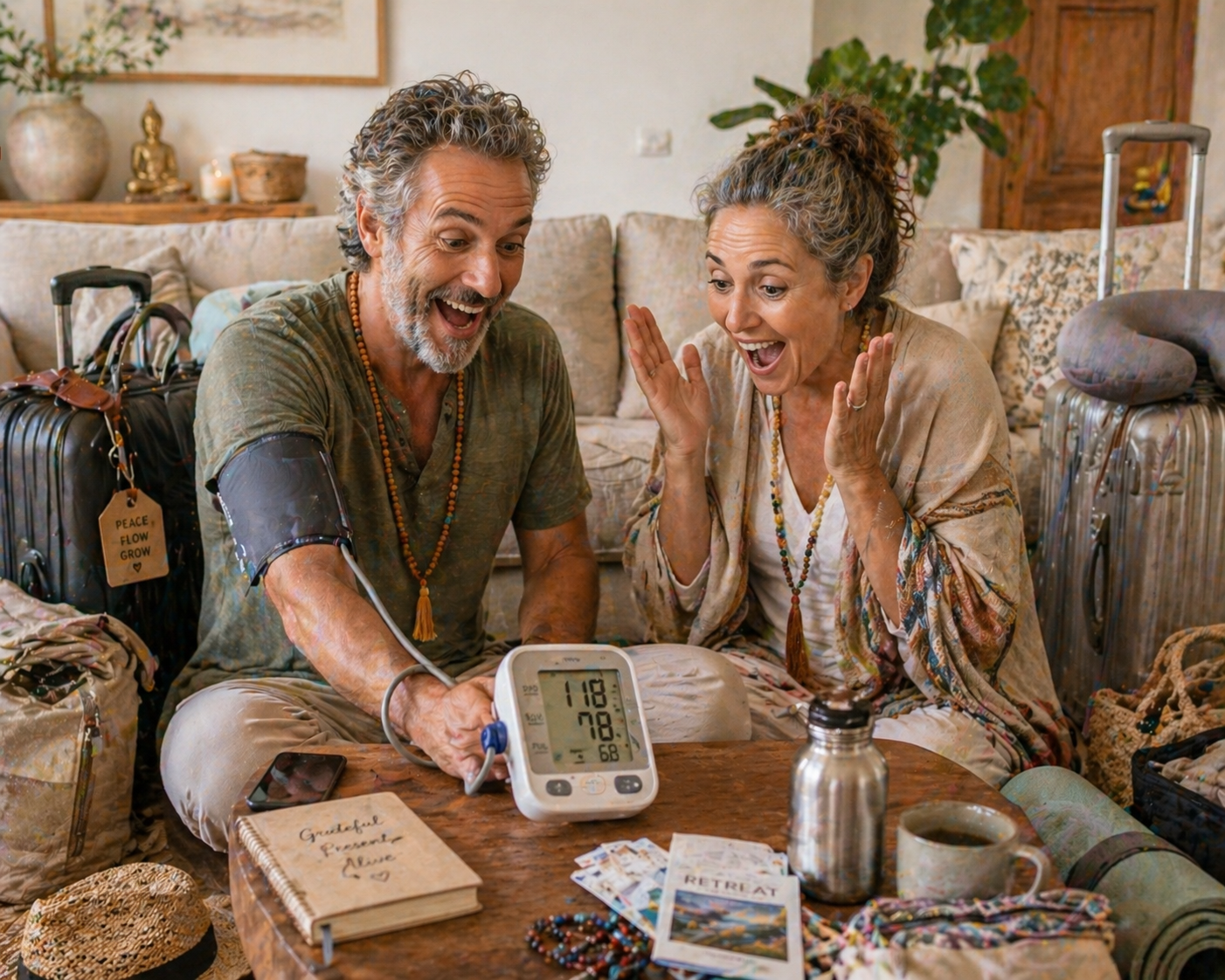
Why People Actually Go on Retreats and What Does Science Say about the Impacts
Every year, millions of people clear their calendars, spend money they thought twice about, fly to a place they've never been, and put themselves in the hands of a guide they've never met — to attend a retreat.
It's worth pausing on how strange this is.
We live in the most informed, most entertained, most resourced era in human history. We have therapists, fitness apps, meditation apps, sleep apps, breathing apps, journaling apps, and a steady stream of optimization advice from every direction. And yet the retreat industry — the act of physically leaving home for a few days to do almost the opposite of what modern life is structured around — is one of the fastest-growing wellness sectors on earth.
Why?
The shallow answer is that retreats are a vacation with vegetables. The deeper answer, and the one this article is about, is that retreats do something measurable to the human nervous system, the cardiovascular system, the immune system, and the psyche — and the research backing this up is now substantial enough to take seriously.
This is not a piece arguing that retreats are magic. It's a piece walking through what the science actually says about what happens when a person attends a well-designed retreat, why it happens, and what the documented benefits look like in real participants. It draws on systematic reviews, randomized controlled trials, and the official position of public health authorities.
The picture that emerges is more interesting than the marketing. The marketing says retreats are transformative. The science says something more useful: retreats reliably re-set human beings in ways that show up in their bodies, their minds, and their relationships — and that those re-sets are exactly the kind of thing modern life makes harder and harder to come by on your own.
What the systematic reviews actually found
The most rigorous look at retreat outcomes is a 2018 systematic review published in BMC Complementary Medicine and Therapies by Naidoo and colleagues, titled The health impact of residential retreats: a systematic review. The reviewers screened the published literature and identified 23 studies — including eight randomized controlled trials — covering a total of 2,592 participants across diverse populations.
Their finding: every single study reported post-retreat health benefits. Not most. Every one.
The benefits documented across the reviewed studies included reductions in blood pressure, weight loss, decreased waist circumference, improvements in metabolic markers, reductions in anxiety and depression scores, and improvements in self-reported quality of life. Some benefits persisted in measurable form up to five years after the retreat ended.
Especially notable: of the four studies that examined retreats designed for cancer patients specifically, all four showed meaningful improvements in quality of life — a population for whom small wins in subjective wellbeing carry enormous weight.
A 2017 observational study published in the Journal of Alternative and Complementary Medicine, Do Wellness Tourists Get Well?, tracked participants through a single week-long retreat and found measurable improvements across multiple dimensions of health and wellbeing — physical, psychological, and metabolic — that held at six-week follow-up.
These are not small studies in obscure journals. They're peer-reviewed work in mainstream medical literature, and the conclusions are consistent: people who go on well-designed retreats come back measurably better than they arrived.
What's happening in the brain and the body
The reason retreats produce these effects isn't mysterious. It's the predictable result of doing several things the modern human body desperately needs, all at once, for several days in a row.
The stress system goes quiet. Modern adults live with chronically elevated cortisol — the body's primary stress hormone — because the ordinary structure of work, news, social media, financial pressure, and family logistics keeps the sympathetic nervous system in a low-grade fight-or-flight state for years on end. Retreats interrupt this. A 2023 study published in Frontiers in Psychology on Heartfulness meditation, anxiety, and stress measured cortisol levels in participants before and after a meditation intervention and found significant reductions (p < 0.001), correlating directly with reductions in self-reported anxiety and stress. Multiple meta-analyses on forest exposure and nature immersion — both standard retreat ingredients — show the same pattern: cortisol drops, parasympathetic nervous system activity rises, the body shifts out of stress mode.
The cellular aging process slows. This is one of the most striking findings in the recent retreat literature. A growing body of research shows that intensive contemplative practice affects telomere biology — the protective caps on the ends of chromosomes that shorten as cells age. Jacobs and colleagues, in a study cited across the field, found that participants in a three-month meditation retreat showed significantly greater telomerase activity (the enzyme that repairs telomeres) than controls. A 2024 review in NIH's PMC database summarizes the broader picture: meditation and yoga interventions are associated with preserved telomere length and increased telomerase activity, mediated through stress reduction and reduced inflammation. This isn't speculation. It's measurable at the cellular level.
Inflammation drops. Chronic low-grade inflammation is increasingly recognized as a root cause underlying everything from heart disease to depression to autoimmune conditions. A 2024 editorial in PMC on residential meditation retreats summarizes findings that retreat participation is associated with reductions in inflammatory markers including CRP, IL-6, and IL-8 — the same biomarkers physicians track to assess long-term disease risk.
Sleep architecture re-sets. A randomized controlled trial of yoga for student mental health published in BMC Psychiatry tracked 202 participants over 24 weeks and found that sleep quality improved significantly post-intervention and remained improved at 24-week follow-up. Retreat participants typically arrive sleep-deprived and leave having had several nights of genuinely restorative sleep, often the first in months — and that re-set tends to extend.
Mood shifts measurably. A 2018 meta-analysis published in Depression and Anxiety on yoga for anxiety covered eight randomized controlled trials and found significant reductions in anxiety symptoms, with large effects compared to active comparator treatments. A separate meta-analysis of yoga for depression found similar results: meaningful reductions in depressive symptoms across multiple controlled trials.
The picture, taken together, is remarkably consistent. Retreats lower cortisol, lower inflammation, raise telomerase activity, improve sleep, reduce anxiety, reduce depression, lower blood pressure, and improve subjective wellbeing. These are not vague spiritual claims. They're physiological measurements taken in laboratory conditions on real participants.
The piece almost no one talks about: community
There's one benefit of retreats that the wellness industry consistently underplays, even though it may be the most important of all.
In May 2023, the U.S. Surgeon General Dr. Vivek Murthy published an 82-page advisory titled Our Epidemic of Loneliness and Isolation. It is one of the most striking public health documents released in the last decade. Its central finding: the mortality impact of social disconnection in modern Western societies is equivalent to smoking up to 15 cigarettes a day. Loneliness is now classified as a public health crisis on par with tobacco, obesity, and the opioid epidemic.
The advisory documents that nearly half of American adults reported measurable loneliness even before the pandemic, and the situation has worsened since. Social isolation is associated with a 50% increased risk of dementia, a 29% increased risk of heart disease, and a 32% increased risk of stroke.
This is the context most participants don't realize they're walking into when they sign up for a retreat.
Retreats are, almost incidentally, one of the few remaining structures in modern life where adults sleep in the same place, eat at the same table, share silence and laughter, and are seen by other humans for multiple days in a row without the mediation of screens. The neuroscience of this is well-established: humans are biologically wired for in-person social connection, and we register its presence at the level of the immune system, the cardiovascular system, and the brain.
A well-designed retreat doesn't just teach yoga or guide a meditation. It quietly delivers something the rest of modern life has stripped out — the experience of being part of a small, present, attentive group. For many participants, this is the first time in years they've experienced it. They return home calling it "life-changing" without quite being able to articulate why.
It's because their bodies registered something they didn't know they were missing.
Why retreats work when ordinary self-care doesn't
A reasonable question to ask is why a retreat produces effects that no app, no online program, and no weekly therapy session reliably matches.
The answer is concentration. Retreats stack five separate evidence-based interventions on top of each other, all running at once, for several days in a row. You can find each ingredient elsewhere — meditation apps, yoga classes, walks in the park, healthy eating, social events. But you almost never find all five compounding simultaneously, in a setting designed to remove the demands and distractions that normally pull you out of any one of them.
This is what makes retreats different from "trying to take care of yourself" at home. At home, you do twenty minutes of yoga and then check your email. You meditate for ten minutes and then drive to work. You eat well at lunch and then have a stressful meeting. The interventions are real but their effects get repeatedly disrupted by the environment that produced the underlying stress.
A retreat removes the disrupting environment for long enough that the body can actually drop its defensive posture. Once it does — sometimes by day two, sometimes by day three — the practices start producing effects that are an order of magnitude larger than they would in fragmented daily life. This is why participants often report that "the same yoga class I do at home felt completely different here." It is the same yoga class. The body around it was different.
This is also why a five-day retreat can produce measurable benefits that persist for weeks or months. The retreat doesn't install a new state. It teaches the body what its non-defensive baseline actually feels like. Once a person has experienced that baseline, they tend to recognize when they've drifted from it, and they have a reference point to return to.
What the participants themselves report
Beneath all the metrics, the studies consistently document something the data alone doesn't fully capture: participants describe their retreats as among the most meaningful experiences of their lives. The word "transformative" appears so often in the qualitative literature that researchers have stopped commenting on it.
What participants describe, when interviewed, falls into a few consistent themes:
A felt experience of what wellbeing can be — not as a concept, but as something they actually inhabited for several days. This becomes a reference point they keep coming back to.
Clarity about decisions, relationships, and priorities that had been clouded by chronic stress and overwhelm. With the noise turned down, what mattered most became visible.
Embodiment — a re-acquaintance with their own body after months or years of living mostly from the neck up. Many participants describe it as remembering they have a body at all.
Connection with the other participants, often forming relationships that persist long after the retreat ends. The participants paid for a retreat and found they also got a small community.
A starting point for sustained change — often the moment people identify in retrospect as when they began to actually take care of themselves, leave a job that was destroying them, end or repair a relationship, or commit to a practice they'd been avoiding.
This is not nothing. This is, by any reasonable measure, one of the most efficient interventions modern life offers for the kinds of problems modern life creates.
What this means for the people considering one
If you're someone considering attending a retreat, the evidence is on your side. The peer-reviewed literature consistently documents that participants come back measurably better — physically, psychologically, biologically — than they arrived. The improvements are real, the mechanisms are understood, and the components are individually validated even if the retreat-as-a-package research is still maturing.
If you're someone considering running a retreat as a guide, retreat leader, or instructor, the evidence is also on your side. You are doing real work that produces real outcomes for real people. The participants who attend your retreats are not buying a luxury vacation. They are participating in one of the few remaining structures in modern life that reliably delivers what their bodies actually need: rest, movement, nature, contemplation, healthy food, and human community in concentrated form.
This is not soft work. It's serious operational work with measurable health outcomes for participants and meaningful business outcomes for leaders who treat it as a craft. We've written separately about why retreat work is among the highest-leverage forms of teaching available today, and about the operational discipline that separates professionals from amateurs.
What the science adds is a quiet kind of permission. Retreat work isn't a wellness fad. It isn't a luxury industry. It is one of the few remaining structures that does, demonstrably, what it claims to do — and the people who participate in it are usually right that what happened to them was real.
That's worth saying out loud, in plain language, to participants who are wondering whether to commit, and to retreat leaders who sometimes lose sight of the magnitude of what they're actually offering.
The research says it works. The participants say it works. The biology says it works. The remaining question is just whether the next person who needs it will find their way to one.
If you're a retreat leader, instructor, or guide thinking about how to build a stronger experience for your participants, we'd love to hear from you. Get in touch.
Further Reading
If this piece resonated, our broader series goes deeper into the operational, financial, and emotional realities of running independent retreats:
- What Is a Retreat, Really? A Deep Look at One of the Oldest — and Most Misunderstood — Human Practices — the foundational definition of the work
- What Makes a Yoga Retreat Genuinely Successful — for Both Teacher and Participants — the operational fundamentals across all three phases of a retreat
- Mountain Climbing Retreat and What Separates Professionals From Amateurs — for context on how operational mastery shows up across retreat verticals
- Why Most Retreat Leaders Quietly Quit After 2-3 Retreats — the structural reasons talented leaders give up, and how to avoid them
- Burnout Recovery Retreats: The Biggest Opportunity in Wellness — a specific retreat vertical sitting on top of the loneliness and chronic stress data
- Nervous System Retreats: The Biggest Opportunity in Wellness — another vertical built directly on the science discussed in this article
- Sound Healing Retreats: From Fringe to Mainstream — how the wellness industry's fastest-growing modalities are catching up to the research
- Digital Detox Retreat Design Guide — for retreat leaders building experiences specifically targeting modern overstimulation
Follow our Facebook page for new articles as they're published.
RetreatsOS is the operational platform built specifically for independent retreat leaders. Public retreat pages, integrated registration, payment plans and deposit collection with automated reminders, a participant management dashboard, the Buddy Bot WhatsApp assistant, and the operational infrastructure that turns the administrative layer of running retreats into a solved problem. The work of designing experiences that produce the health outcomes documented in this article doesn't happen in software — but the operational layer that gives you the bandwidth to do that work well does. Learn more at retreatsos.com.